
You Would Not Build a Skyscraper Without an Architect. Why Build Software Without One?
You would not construct a skyscraper without an architect. Yet every day, businesses are building software without architectural oversight, creating systems that are structurally fragile.
Software Needs Architecture, Not Just Code
You would not construct a skyscraper without an architect. Yet every day, businesses are doing exactly that with software.
No investor would commit millions to a high-rise project and simply hand builders a pile of materials with instructions to "figure it out as you go." There are blueprints, structural calculations, material standards, safety considerations, and long-term maintenance planning.
We see the adverts constantly:
Build your own app.
Generate your platform with AI.
Launch in a weekend.
Rapid development tools and AI-generated code can be incredibly powerful. They move ideas quickly and help prototypes become real products faster than ever before.
The problem is not speed.
The problem is architecture.
The Hidden Cost of "Just Make It Work"
When software is generated without experienced architectural oversight, what you often end up with is not a cohesive system, but a collection of scripts that happen to work together.
Functions are duplicated in multiple places.
Validation logic is written three different ways.
Authentication is bolted on after the fact.
Business rules are scattered across controllers, services, and UI layers.
It works. Until it does not.
Without architectural control:
- Code reuse declines
- Technical debt increases
- Maintenance becomes unpredictable
- Security gaps multiply
- Scaling becomes expensive
The system may function, but it is structurally fragile.
The Security Footprint Problem
This is where the risk becomes serious.
AI can generate code. It can generate a lot of code. But more code does not mean better software.
Every endpoint, every duplicated function, and every inconsistent validation path increases what we call the security footprint.
The larger the surface area of your system, the more potential attack vectors exist.
If three modules implement authentication slightly differently, you now have three potential weaknesses instead of one hardened, centrally controlled mechanism.
If business rules are repeated instead of abstracted, you increase the likelihood that one path will be missed during patching.
A small, well-designed system has a narrow and defensible attack surface. A rapidly assembled system without architectural governance has a broad and unpredictable one.
Hackers do not need the whole system to fail.
They only need one inconsistency.
Architecture Is Not Slowing You Down. It Is Protecting You.
A software architect does not just design structure. They design constraints.
They define:
- Clear domain boundaries
- Reusable service layers
- Consistent validation patterns
- Centralised security controls
- Controlled data flow
- Future scalability paths
Architecture reduces duplication.
Architecture reduces surface area.
Architecture reduces risk.
And importantly, architecture makes AI safer to use. AI is a powerful tool when guided by structured design; without structure, it amplifies inconsistency at scale.
Build Like It Matters
At Libertas Software Research Ltd, we view software the same way engineers view infrastructure.
That mindset is embedded in how we build products like PrimeCRM and Ordu Studio: architected for long-term resilience, not short-term convenience.
You can build quickly.
Or you can build correctly.
The most successful organisations do both, because they understand that speed without structure eventually costs more than it saves.
If you would not build a skyscraper without an architect,
do not build mission-critical software without one.
Your future scalability, maintainability, and security depend on it.
Are you Ready?
Ready to transform your ideas into reality?
Join the successful organisations using Libertas Software Research to build and design powerful software solutions to meet their needs.
Clients






Latest Knowledge Hub Articles
Latest Knowledge Hub Articles

2 min read
Libertas Software Research has been shortlisted for Innovative Company of The Year at the AIB Business Eye Awards, with winners announced on 22nd October 2026 at ICC Belfast.

13 min read
How do you let trusted third parties contribute information to a live multi-agency incident without giving them unnecessary access to the central incident management system, or requiring them to open their own systems in return? That is one of the problems ORDU Connect is built to solve.
3 min read
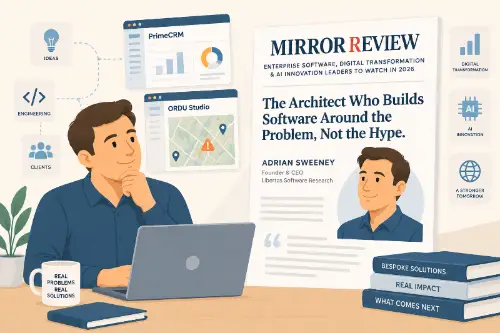
Libertas Software Research has been featured in Mirror Review's Enterprise Software, Digital Transformation & AI Innovation Leaders to Watch in 2026 list, with a profile on our founder, Adrian Sweeney.
Newsletter
Connect on LinkedIn