
The Hidden Cost of “Quick Software”
What starts as a quick software fix often becomes permanent infrastructure, introducing long-term maintenance, security, and operational risk.
The Hidden Cost of “Quick Software”
In almost every organisation there comes a moment when someone says, “We just need something quick.” It might be a small internal tool, a dashboard, a workflow system, or a simple customer portal. The intention is usually reasonable. Build something small, solve the immediate problem, and move on.
However, what begins as a quick solution often becomes permanent infrastructure. That is where the hidden cost begins.
The Difference Between Prototype Software and Production Software
Prototype software exists to test an idea. Its purpose is speed. It allows teams to experiment, validate assumptions, and determine whether a concept is viable. In many cases prototypes are intentionally lightweight because their job is simply to prove that something can work.
Production software is very different. Production systems must survive change, scale, and scrutiny. They must be secure, maintainable, observable, and resilient. They must integrate with other systems and support long-term operational processes across teams and departments.
The real problem begins when a prototype quietly becomes the production system. This happens far more often than organisations realise. A small internal script becomes the tool everyone depends on. A simple database grows into the core system holding operational data. A quick dashboard becomes the platform leadership relies on for decision making.
What was never designed to carry weight suddenly carries the entire organisation.
Why Shortcuts Become Permanent Infrastructure
Software has a unique characteristic compared with most other tools. Once people begin using it, it becomes difficult to replace. Processes form around it, data accumulates inside it, and teams begin depending on it for daily operations.
Even if the system was originally intended to be temporary, replacing it eventually feels risky. Instead of rebuilding it properly, organisations begin patching the system, extending it, and adding more scripts and features around the original foundation.
Over time the system grows into something large, fragile, and difficult to understand. What started as a quick solution slowly becomes the permanent infrastructure that the organisation depends upon.
Technical Debt Is Operational Risk
Technical debt is often discussed as a developer inconvenience, but in reality it is an operational risk. When systems lack structure and architectural planning, even simple changes can introduce unexpected side effects.
Security vulnerabilities become harder to identify and fix. Onboarding new engineers becomes slow and expensive because understanding the system requires navigating years of unstructured growth. Integrations become fragile and reliability begins to decline.
The organisation effectively begins paying interest on every change. Tasks that once took days begin taking weeks, and work that once required a single engineer may now require an entire team. The cost does not appear immediately. It accumulates slowly over time until the system reaches a point where change becomes extremely difficult.
Why Early Architecture Reduces Cost
There is a common misconception that architecture slows projects down. In reality, good architecture reduces long-term cost and risk because it establishes clear foundations before complexity grows.
Architecture does not mean overengineering. It simply means making deliberate decisions about system boundaries, data ownership, security models, extensibility, and operational monitoring.
A well-structured system allows teams to move faster later because the foundations support change rather than resist it. When architecture is absent, every new change becomes excavation work where engineers must carefully navigate fragile code before adding anything new.
Why Your AI Needs Governance
The rise of AI-generated software has accelerated this challenge. AI tools can generate functional code incredibly quickly, making prototyping faster than ever before.
However, AI does not own the long-term responsibility for the system it generates. Without architectural oversight, AI-generated systems often produce fragmented codebases with multiple implementations of the same logic, inconsistent security patterns, redundant services, and an ever-expanding attack surface.
The result is software that works today but becomes increasingly difficult to manage tomorrow. AI is an incredibly powerful tool, but like any powerful tool it requires governance. Architecture provides that governance and ensures that speed does not sacrifice structure.
The Real Cost of “Quick”
Quick software is rarely cheap. The cost simply arrives later, hidden inside maintenance, instability, security risk, and operational complexity.
Organisations that treat architecture as a strategic discipline build systems that last longer, evolve faster, and carry far less operational risk. In software, just like in construction, the foundation determines the lifetime of the structure.
This is the same principle behind PrimeCRM, where governance, architecture, and operational durability are treated as non-negotiable from day one.
Are you Ready?
Ready to transform your ideas into reality?
Join the successful organisations using Libertas Software Research to build and design powerful software solutions to meet their needs.
Clients






Latest Knowledge Hub Articles
Latest Knowledge Hub Articles

2 min read
Libertas Software Research has been shortlisted for Innovative Company of The Year at the AIB Business Eye Awards, with winners announced on 22nd October 2026 at ICC Belfast.
13 min read
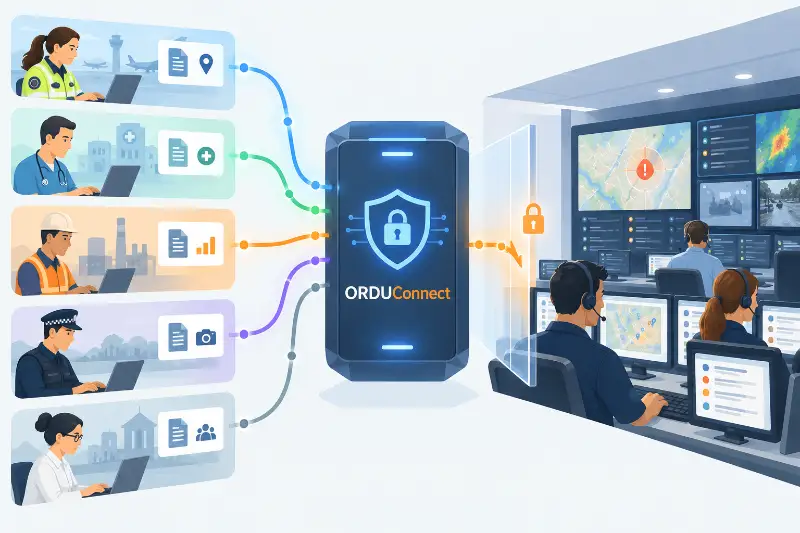
How do you let trusted third parties contribute information to a live multi-agency incident without giving them unnecessary access to the central incident management system, or requiring them to open their own systems in return? That is one of the problems ORDU Connect is built to solve.
3 min read
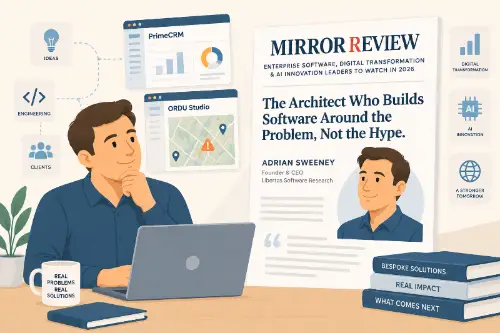
Libertas Software Research has been featured in Mirror Review's Enterprise Software, Digital Transformation & AI Innovation Leaders to Watch in 2026 list, with a profile on our founder, Adrian Sweeney.
Newsletter
Connect on LinkedIn