
Why Organisations Eventually Need a Software Research Partner
In many organisations software is no longer just a tool used by a few departments. It has quietly become part of the operational foundation of the business. Customer management, reporting, compliance, communication, and internal processes are all increasingly driven by systems that store, process, and distribute information across the organisation. Even companies that do not consider themselves technology companies are now deeply dependent on software.
This shift has happened gradually. Systems were introduced to solve individual problems, automate tasks, or support specific teams. Over time these systems became interconnected and embedded into daily operations. At a certain point software stops being a collection of tools and becomes infrastructure that the organisation relies on to function.
Software Is Now a Strategic Asset
For senior leadership, software is no longer simply an IT concern. It directly affects operational efficiency, decision making, and the organisation’s ability to respond to change. Systems that manage data, automate workflows, and integrate information across departments shape how effectively the organisation can operate.
When software is well designed it enables clarity, efficiency, and scalability. When it is poorly structured it introduces friction, delays, and risk. Leadership teams often begin to notice this when operational changes take far longer to implement than expected or when reporting requires significant manual effort to produce reliable information.
How Internal Systems Gradually Become Critical Infrastructure
Many organisations begin their software journey with relatively small tools. A reporting dashboard, a workflow tracker, or a simple internal application built to solve a specific problem. These systems are often introduced quickly because they provide immediate value.
Over time, however, additional processes begin to depend on these tools. Integrations are added, data begins to flow between systems, and teams build new processes around them. What started as a small internal tool gradually becomes embedded into the organisation’s operational fabric. Eventually removing or replacing it would disrupt multiple departments and workflows.
The Hidden Complexity Behind Business Software
One of the challenges with operational software is that its complexity is rarely visible at first glance. Systems interact with databases, external platforms, reporting tools, and internal workflows. Data moves between systems in ways that are not always fully documented or understood.
This hidden complexity becomes apparent when organisations attempt to extend, integrate, or replace systems. A change that appears straightforward can reveal dependencies across multiple systems and processes. Without a clear architectural understanding of how these systems interact, organisations often struggle to evolve their software environment safely.
Why Traditional Software Development Approaches Fall Short
Many software development providers focus primarily on delivering features or building applications to meet a specific requirement. While this approach can work well for discrete projects, it often overlooks the broader operational context in which the software will exist.
When systems become central to operations, development decisions must consider long term architecture, integration strategy, and operational resilience. Building features alone is not enough. The organisation needs a deeper understanding of how systems should evolve over time to support business objectives.
The Role of Software Research
Software research focuses on understanding how technology supports operational processes, how systems interact with each other, and how software environments can evolve sustainably over time. It involves analysing workflows, identifying architectural patterns, and designing systems that can adapt as organisational needs change.
Rather than starting with a specific product or feature, research begins with the operational problem. It examines how information flows through the organisation, where inefficiencies exist, and how technology can be structured to support more reliable and scalable operations.
What a Software Research Partner Actually Does
A software research partner works alongside leadership and operational teams to understand how the organisation functions and how technology supports that operation. This involves analysing existing systems, identifying architectural risks, and designing strategies for improving how software infrastructure supports the business.
The goal is not simply to build software but to create systems that align with the organisation’s operational structure and long term objectives. This approach ensures that technology decisions are made with a clear understanding of their strategic implications.
The Strategic Advantage of Research Led Software Development
Organisations that approach software development through research and architectural design gain a significant advantage. Their systems are more adaptable, integrations are planned rather than improvised, and operational processes are supported by software designed with long term stability in mind.
This reduces operational risk and enables the organisation to evolve its systems as requirements change. Instead of repeatedly replacing or patching systems, the organisation builds a technology environment that can grow and adapt alongside the business.
When Organisations Realise They Need One
Many organisations reach a point where their software environment becomes difficult to manage. Integrations become fragile, reporting becomes inconsistent, and operational changes require significant effort from technical teams.
This moment often coincides with growth, regulatory changes, or the need to modernise legacy systems. Leadership begins to recognise that technology decisions have long term consequences and that a more structured approach to system design and evolution is required.
How Libertas Software Research Approaches These Challenges
Libertas Software Research focuses on researching, designing, and evolving complex operational software systems. Rather than treating software as a series of isolated projects, the focus is on understanding the broader operational environment in which those systems exist.
By combining architectural thinking with practical system development, LSR helps organisations build technology infrastructure that supports long term operational resilience. The objective is to ensure that software continues to enable the organisation rather than becoming a constraint on its growth.
Conclusion
As organisations become increasingly dependent on software to operate, the importance of structured system design and architectural thinking continues to grow. Technology decisions are no longer isolated technical choices. They shape how the organisation operates and how effectively it can adapt to future challenges.
For many organisations, partnering with a software research organisation provides the expertise needed to navigate this complexity. By approaching software as a strategic capability rather than a collection of tools, organisations can build systems that support long term stability, efficiency, and growth.
Are you Ready?
Ready to transform your ideas into reality?
Join the successful organisations using Libertas Software Research to build and design powerful software solutions to meet their needs.
Clients






Latest Knowledge Hub Articles
Latest Knowledge Hub Articles

2 min read
Libertas Software Research has been shortlisted for Innovative Company of The Year at the AIB Business Eye Awards, with winners announced on 22nd October 2026 at ICC Belfast.
13 min read
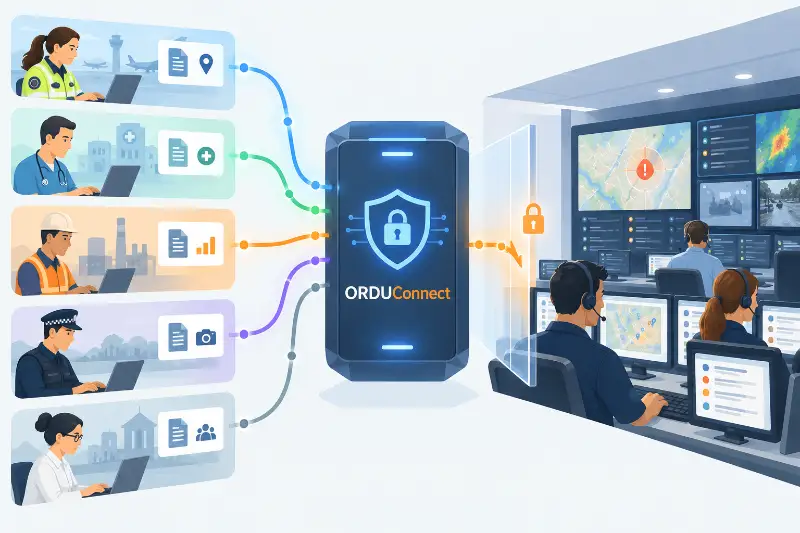
How do you let trusted third parties contribute information to a live multi-agency incident without giving them unnecessary access to the central incident management system, or requiring them to open their own systems in return? That is one of the problems ORDU Connect is built to solve.
3 min read
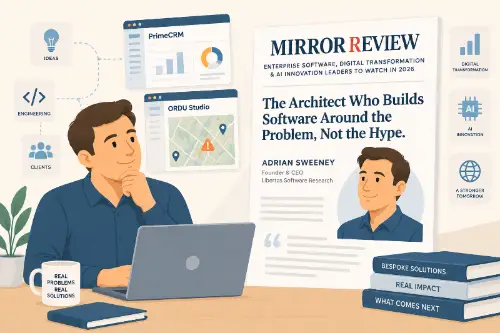
Libertas Software Research has been featured in Mirror Review's Enterprise Software, Digital Transformation & AI Innovation Leaders to Watch in 2026 list, with a profile on our founder, Adrian Sweeney.
Newsletter
Connect on LinkedIn