
Software Development :: If You Don’t Control Change, You Don’t Control the Budget
Keeping to a client’s budget is often misunderstood as an exercise in limiting change, when in reality it is about understanding and controlling it properly as the project evolves.
Budget Is Not About Limiting Change
Where Most Software Projects Start
Most enquiries around software start in the same place. An organisation has an existing process, often something that has grown over time, and they want to turn it into a usable application that improves efficiency, visibility, and control.
At first glance, that sounds straightforward. The process already exists, so the assumption is that it can simply be translated into software. In many cases, that is true. If the business understands the process and can document it clearly, then you are already at the starting line.
From a leadership perspective, that should feel like a position of control. The organisation knows what it does, how it operates, and what it needs the system to support.
When the Process Becomes Visible
The challenge begins when that process starts to take shape inside a system.
As soon as it becomes visible, people begin to see it differently. They become engaged, they see how it can evolve, and they start to recognise new opportunities. New ideas emerge, edge cases are identified, and different stakeholders interpret how it should work in slightly different ways. This is not a failure, it is a natural part of making a process explicit.
At this point, even simple sounding changes need to be reviewed from every perspective and across every stage of the process. What appears minor in isolation can have wider implications, particularly where multiple roles, decisions, and dependencies are involved.
What Stakeholders Focus On vs What the Organisation Needs
In well-structured software delivery, the focus is on what matters most to the organisation, not just what is being asked for by stakeholders. In many cases, that includes auditability, which is critical to the organisation but often overlooked in favour of additional features.
Stakeholders naturally focus on what they want the system to do. They are rarely focused on how those changes need to be implemented, recorded, and governed once the system is in operation.
Why Small Changes Are Not Small
This changes the nature of even the simplest request. A small adjustment is no longer just a technical change, it becomes part of a controlled and traceable process. As a result, what appears minor can carry a much larger impact once compliance, accountability, and operational visibility are considered.
Control Defines Outcome
If change is not controlled, then neither is the outcome.
What begins as a well-defined initiative can quickly become something else entirely, not through poor intent, but through a lack of structure around how decisions are made as the system evolves. The cost is not just financial. It is measured in time, complexity, operational disruption, and loss of clarity.
This is where many organisations lose control without realising it.
They believe they are managing delivery, when in reality the direction of the system is being shaped incrementally by unmeasured change.
This is exactly where Libertas Software Research operates.
Not simply in building systems, but in ensuring that those systems remain aligned with the organisation as they evolve. That means creating structure around change, making its impact visible, and ensuring that every decision is understood in the context of cost, time, and long-term operation.
The question is not whether change will happen.
It will.
The question is who is controlling it.
Are you Ready?
Ready to transform your ideas into reality?
Join the successful organisations using Libertas Software Research to build and design powerful software solutions to meet their needs.
Clients






Latest Knowledge Hub Articles
Latest Knowledge Hub Articles

2 min read
Libertas Software Research has been shortlisted for Innovative Company of The Year at the AIB Business Eye Awards, with winners announced on 22nd October 2026 at ICC Belfast.
13 min read
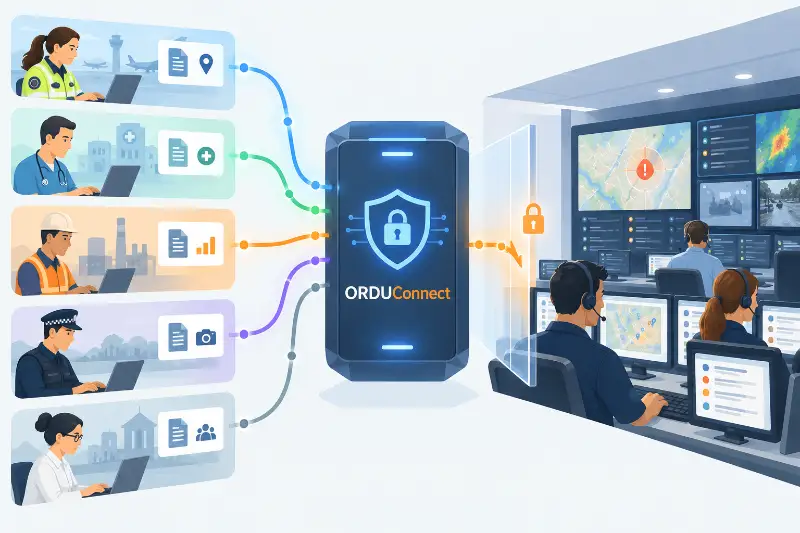
How do you let trusted third parties contribute information to a live multi-agency incident without giving them unnecessary access to the central incident management system, or requiring them to open their own systems in return? That is one of the problems ORDU Connect is built to solve.
3 min read
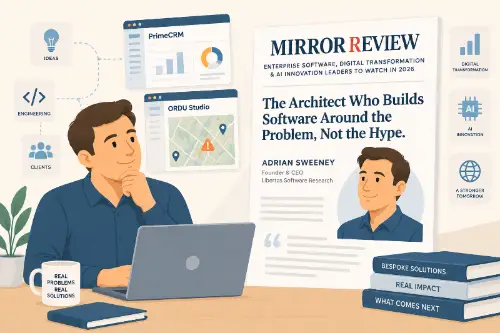
Libertas Software Research has been featured in Mirror Review's Enterprise Software, Digital Transformation & AI Innovation Leaders to Watch in 2026 list, with a profile on our founder, Adrian Sweeney.
Newsletter
Connect on LinkedIn