
Understanding MAIMS: Why Modern Incident Management Systems Are No Longer Optional
Multi Agency Incident Management Systems have moved from optional to essential. Explore why traditional approaches fall short and how modern platforms are closing the gap between planning and execution.
Major incidents do not fail because of a lack of effort. They fail because of breakdowns in coordination.
Across local authorities, healthcare systems, emergency services and industrial environments, incident response has historically relied on a combination of static plans, manual communication, and institutional knowledge. While frameworks such as the UK's Civil Contingencies Act and the JESIP principles provide structure, the operational reality is often far more fragmented.
This is the environment in which Multi Agency Incident Management Systems (MAIMS) have emerged.
What is MAIMS in Practice
MAIMS is not a single product or standardised platform. It is a category of systems designed to support:
- Multi-agency coordination
- Real-time situational awareness
- Structured decision-making
- Accountability and auditability
- Execution of pre-defined response plans
In theory, MAIMS provides a shared operational picture across organisations. In practice, the maturity of implementation varies significantly.
Some organisations rely on adapted logging tools or document repositories. Others use bespoke systems that attempt to digitise incident workflows. A small number have begun integrating real-time data feeds, communications, and tasking into unified platforms.
Despite these differences, the underlying objective remains consistent: to reduce ambiguity during high-pressure, time-critical events.
The Structural Problem: Fragmentation
Research and post-incident reviews repeatedly highlight the same issue. Information is available, but it is not aligned.
Typical failure points include:
- Critical updates held in separate systems or channels
- Decisions made verbally without structured recording
- Delays in disseminating information across agencies
- Lack of clarity over responsibility and task ownership
- Difficulty maintaining a single, verified "source of truth"
Even in well-rehearsed environments, coordination often depends on individuals bridging gaps manually. This introduces risk, particularly when incidents escalate or span multiple organisations.
The Limits of Traditional Approaches
Most councils and agencies already have incident plans. These are often detailed, compliant, and regularly reviewed.
The limitation is not planning. It is execution.
Static documents cannot adapt in real time.
Email chains do not scale under pressure.
Phone calls do not create an audit trail.
Spreadsheets do not provide shared situational awareness.
As incidents become more complex, involving infrastructure, healthcare, environmental risk, and public communication, these limitations become more pronounced.
Command Structures Without System Support
The UK's Gold, Silver, Bronze model provides a clear hierarchy for decision-making. However, without supporting systems, this structure relies heavily on interpretation and communication discipline.
Strategic intent defined at Gold level must be translated into coordinated action at Silver and executed at Bronze. Without a system to enforce structure, track actions, and maintain visibility, this translation is prone to delay and distortion.
The result is not necessarily failure, but inefficiency at exactly the point where time and clarity matter most.
The Evolution Toward Integrated Platforms
Modern MAIMS platforms attempt to address these gaps by combining several capabilities:
- Pre-configured response planning (digitised playbooks)
- Real-time incident logging and timeline management
- Task assignment and tracking across roles and agencies
- Integrated communication channels
- Controlled information sharing with trusted external parties
- Full audit trails for post-incident review
The direction of travel is clear. Incident management is moving from document-led processes to system-led coordination.
However, many existing solutions remain either too rigid, too generic, or too disconnected from the realities of live incident response.
Where Current Solutions Fall Short
A recurring issue in MAIMS adoption is that systems are often built either:
- From a compliance perspective, focusing on documentation rather than execution
- Or from a technical perspective, without deep grounding in operational response environments
This leads to platforms that are either underused during live incidents or bypassed entirely in favour of informal communication.
For a system to be effective, it must reflect how incidents actually unfold. That includes uncertainty, incomplete information, and the need for rapid decision-making under pressure.
Conclusion: Why ORDU Was Built
The gap between planning and execution is where most incident management systems struggle.
ORDU was built to operate in that gap.
Informed by real-world emergency response experience, including the operational insight of Dr Peter Daly, former Chief Emergency Management Officer for Ireland's Health Service Executive, the system has been designed around the realities of live coordination rather than theoretical workflows.
The objective is not to replace existing structures such as Gold, Silver, Bronze, but to enable them to function as intended under real conditions.
This means:
- Turning plans into executable steps
- Ensuring actions are visible, assigned, and tracked
- Maintaining a single, reliable operational picture
- Enabling communication across organisational boundaries without fragmentation
MAIMS as a concept is not new. The need for it has been recognised for decades.
What is changing is the expectation that coordination should be supported by systems capable of operating at the same speed and complexity as the incidents themselves.
That is the problem ORDU is designed to solve.
Disclaimer: When we originally published this post, we incorrectly stated Dr Peter Daly's former title as Chief Emergency Medical Officer. This was incorrect — his correct title was Chief Emergency Management Officer. We apologise for the error.
Are you Ready?
Ready to transform your ideas into reality?
Join the successful organisations using Libertas Software Research to build and design powerful software solutions to meet their needs.
Clients






Latest Knowledge Hub Articles
Latest Knowledge Hub Articles

4 min read
Libertas Software Research was a finalist in the Innovative Company of the Year category at the Business Eye Awards 2026, and congratulates CV6 Therapeutics on being named the winner.
4 min read
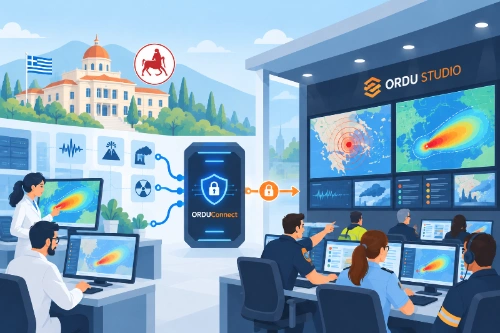
How ORDU Connect brings University of Thessaly earthquake and plume modelling into a live incident through the Secured Verified 3rd Party route, so every agency sees the same trusted analysis at the same moment.

2 min read
Libertas Software Research has been shortlisted for Innovative Company of The Year at the AIB Business Eye Awards, with winners announced on 22nd October 2026 at ICC Belfast.
Newsletter
Connect on LinkedIn