
A Late-Night Catch-Up on WhatsApp Revealed a Troubling Security Flaw
It started with something totally routine: catching up on a group chat. The night before, some friends had been deep in conversation—memes, jokes, late-night hot takes.
I'd gone to bed early, so the next morning I grabbed my phone, opened WhatsApp, and scrolled back to see what I'd missed.
But instead of diving straight into the conversation, I was greeted with a full-screen prompt asking for my two-step verification PIN—a feature I'd enabled months ago for added security. So far, so good but can you spot the problem?
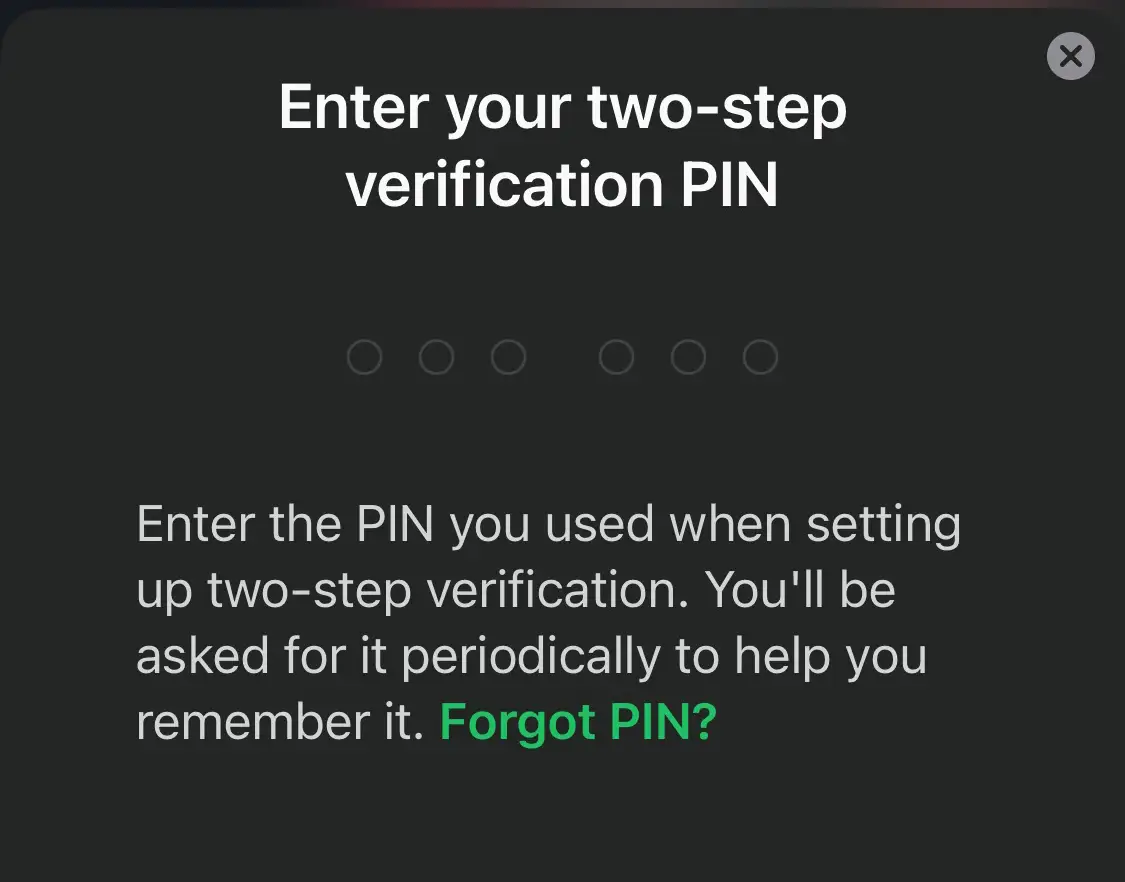
This is a security feature to keep my chats private so why is there a close icon? This is a bad UI design choice and I've worked with enough designers to know that a good one would have picked up on it and if they didn't then a good Developer should have caught this. What went wrong at meta?
Without thinking, I tapped the “X” in the top-right corner of the screen. I assumed it would cancel the login flow or maybe send me back to the previous screen—it was instinctual, something I've done in countless other apps. But what happened next caught me completely off guard: the dialog simply vanished, and I was dropped straight into the app as if the extra layer of security didn't exist at all.
At first, I wasn't sure what had happened. Did the app silently verify my identity some other way? I locked WhatsApp, reopened it, and tested again. Same result: the “X” cancels the PIN prompt and grants full access. In one tap, I'd bypassed my own two-step verification and compromised the very feature I thought was protecting my account.
What Should Have Been a Wall Was Just a Door Left Ajar
Once I realized what had just happened, a sinking feeling hit me. This wasn't an obscure bug or a hidden setting—it was part of the default flow. WhatsApp asks for my PIN, but then hands me an escape hatch. That “X” isn't a courtesy; it's a fatal flaw in logic.
Two-step verification should be a firm barrier preventing unauthorized access. Here, it's treated like a suggestion. And that's a UX decision with real security consequences.
Why This Matters More Now Than Ever
On its own, this oversight is concerning. But it's happening precisely as Meta pushes its AI deeper into WhatsApp—introducing chatbots, AI-suggested replies, and smart search features that touch on the most personal aspects of our communications. The more AI is woven into the fabric of an app, the higher the stakes become for privacy and security.
When an AI assistant in your messaging app can nudge you to share information, it relies on a foundation of trust and robust controls. If the very measure designed to stop unauthorized entry can be discarded with a tap, what does that say about the app's commitment to protecting your data?
Design Choices Reflect Priorities
As someone who reviews interfaces professionally, I know that nothing in a product like WhatsApp happens by accident. If there's an “X,” someone designed it. If tapping that “X” bypasses security, someone signed off on it. That choice—whether intentional or overlooked—sends a clear message: usability is being prioritized over security at a moment when it shouldn't be.
Millions of users enable two-step verification believing it will lock their account safe. When that trust is broken, it isn't just a matter of a few tech-savvy users noticing a flaw—it erodes confidence for everyone.
A Quiet Precedent
Right now, it's a dismissible PIN prompt. Tomorrow, it could be AI-driven nudges to share more data or automated features that slip under the radar. Every time a security feature is treated as optional, we set a precedent for privacy features being negotiable rather than mandatory.
It's not alarmist to say that how security is implemented today shapes the future of digital privacy. If Meta can't secure a basic PIN screen in WhatsApp, how can we trust it with deeper AI-powered access to our most private conversations?
Final Thoughts and Call to Action
I didn't set out to uncover a security flaw when I picked up my phone to catch up on a chat. But that one tap—dismiss, enter, access—changed my view of WhatsApp's security model. And it left me wondering: if a critical two-step verification check can be bypassed so easily, what other protections are quietly being eroded?
And let's not forget that Meta “at the time Facebook” added code to their apps at one stage to take all of your call data and SMS messages. Ok they used permissions to enable it but most people opted into that without knowing they had or wondering why a corporation would want to take their personal information. With Meta now putting AI into the WhatsApp application with the ability to data mine all of your chats. It is only a matter of time before governments tell Meta to extract all data on the phone for a specific individual or a group of people.
Are you Ready?
Ready to transform your ideas into reality?
Join the successful organisations using Libertas Software Research to build and design powerful software solutions to meet their needs.
Clients






Latest Knowledge Hub Articles
Latest Knowledge Hub Articles

2 min read
Libertas Software Research has been shortlisted for Innovative Company of The Year at the AIB Business Eye Awards, with winners announced on 22nd October 2026 at ICC Belfast.

13 min read
How do you let trusted third parties contribute information to a live multi-agency incident without giving them unnecessary access to the central incident management system, or requiring them to open their own systems in return? That is one of the problems ORDU Connect is built to solve.

3 min read
Libertas Software Research has been featured in Mirror Review's Enterprise Software, Digital Transformation & AI Innovation Leaders to Watch in 2026 list, with a profile on our founder, Adrian Sweeney.
Newsletter
Connect on LinkedIn