
From MVP to Product: Strengthening the Foundations of PrimeCRM
PrimeCRM was originally built with a clear goal: validate a new approach to website-driven CRM that reduces platform costs while using AI to intelligently generate, manage, and optimise content.
PrimeCRM was originally built with a clear goal: validate a new approach to website-driven CRM that reduces platform costs while using AI to intelligently generate, manage, and optimise content, structure, and lead capture. Like many early-stage platforms, the initial focus was speed to market rather than architectural perfection.
At the MVP stage, PrimeCRM powered two live websites using effectively the same source code. While this meant that changes had to be applied twice, the approach was intentional. It allowed us to move quickly, test real-world usage, and prove the value of the system with minimal friction. For an MVP, that trade-off made commercial sense.
As PrimeCRM gained traction, however, the limitations of duplicated code became increasingly clear. Every enhancement required additional development effort, testing cycles were longer than necessary, and the risk of divergence between implementations increased. While manageable at a small scale, this approach would not support sustainable growth or commercial deployment.
We have now completed a key milestone in PrimeCRM's evolution from MVP to product. Both websites have been fully migrated onto a single shared core codebase. This unified architecture means PrimeCRM now operates as a true multi-deployment platform, with one central system powering multiple sites and use cases.
The commercial benefits of this shift are substantial. Features are built once and deployed everywhere, significantly reducing development time. Testing is streamlined through a single source of truth, improving reliability and stability. Ongoing maintenance costs are lower, and new functionality can be delivered faster and with greater confidence.
Most importantly, this architectural consolidation positions PrimeCRM for scale. It allows us to onboard additional websites and clients without proportional increases in engineering effort, while continuing to refine AI-driven automation, lead intelligence, and content management capabilities.
"Moving from MVP to product is not just about adding features. It is about making deliberate architectural decisions that support long-term growth. Consolidating PrimeCRM into a single shared core codebase represents that transition. It allows us to move faster, reduce risk, and focus our effort on delivering real value rather than managing technical duplication."
Adrian Sweeney
Founder and CEO, Libertas Software Research Ltd
This milestone marks an important step forward for PrimeCRM as a commercially viable platform, built to support long-term clients, continuous innovation, and scalable growth.
Are you Ready?
Ready to transform your ideas into reality?
Join the successful organisations using Libertas Software Research to build and design powerful software solutions to meet their needs.
Clients






Latest Knowledge Hub Articles
Latest Knowledge Hub Articles

2 min read
Libertas Software Research has been shortlisted for Innovative Company of The Year at the AIB Business Eye Awards, with winners announced on 22nd October 2026 at ICC Belfast.
13 min read
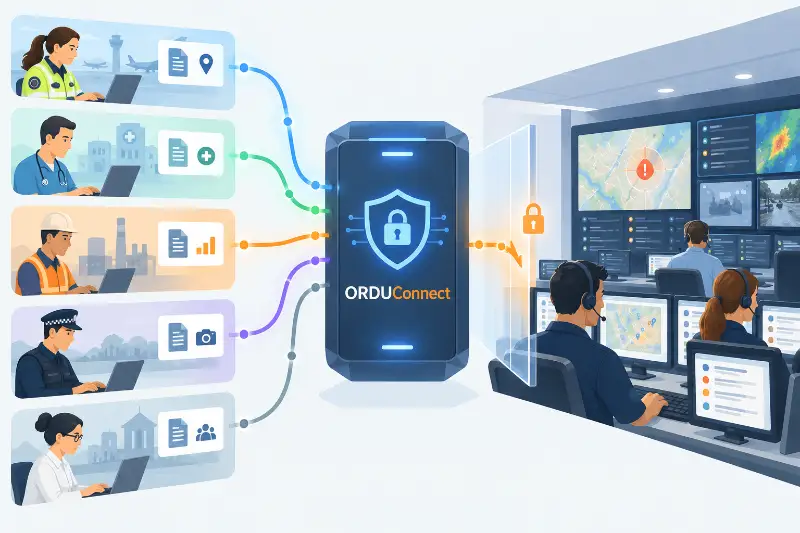
How do you let trusted third parties contribute information to a live multi-agency incident without giving them unnecessary access to the central incident management system, or requiring them to open their own systems in return? That is one of the problems ORDU Connect is built to solve.
3 min read
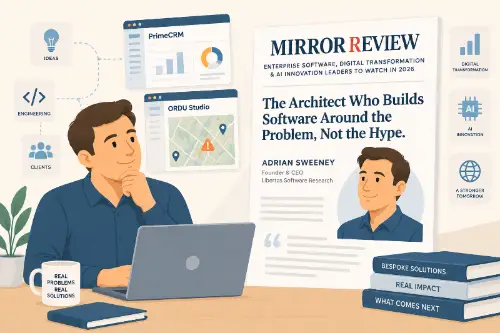
Libertas Software Research has been featured in Mirror Review's Enterprise Software, Digital Transformation & AI Innovation Leaders to Watch in 2026 list, with a profile on our founder, Adrian Sweeney.
Newsletter
Connect on LinkedIn