
From Earthquake to Plume: Bringing University of Thessaly Modelling into a Live Incident
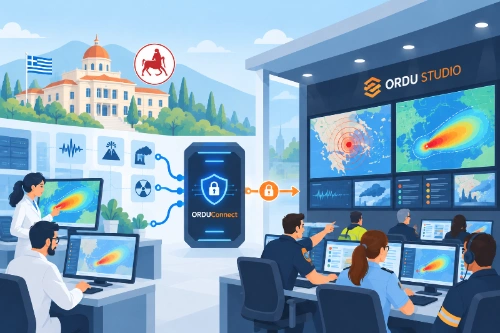
How ORDU Connect brings University of Thessaly earthquake and plume modelling into a live incident through the Secured Verified 3rd Party route, so every agency sees the same trusted analysis at the same moment.
In a major incident, the best science in the world is useless if it arrives after the decision has been made. Commanders need to know how far a gas cloud will travel, or which populations an earthquake has hit hardest, while there is still time to act on it.
Today, that expertise usually sits outside the incident. It lives in a university lab, a research institute or a specialist agency, and getting it into the room means phone calls, emailed PDFs and a lot of hoping. Each handoff costs minutes, and each unverified file raises a fair question: can we trust this?
That gap is what we built ORDU Studio's external data route to close. And the first organisation to travel it is the University of Thessaly in Greece.
ORDU Connect and the Secured Verified 3rd Party
ORDU Connect is the part of ORDU Studio that brings external data sources into a live incident. It is deliberately strict about who gets in.
The only route through which that access is granted is the Secured Verified 3rd Party, or SV3P. An organisation becomes an SV3P only after it has been vetted and secured. Nobody can simply plug a feed into an incident and hope for the best. For a commander, that means anything arriving through this route has a known origin and a verified chain behind it, which matters when lives depend on the numbers.
What it looks like in a live incident
The workflow is built to be quick, because incidents are not patient.
- A commander working an active incident in ORDU Studio requests a plume analysis.
- ORDU Connect asks a short set of questions about the event, so the model has what it needs.
- The request goes to the University of Thessaly through the secured SV3P route.
- UTH's AI modelling runs, and the resulting report is sent straight back into the incident.
The report lands where everyone working the incident can see it, rather than in one person's inbox. Every agency in the response sees the same picture at the same moment.
Why the University of Thessaly
Greece sits on one of Europe's most active seismic zones, so earthquake impact is not an abstract research topic for the University of Thessaly. Its modelling covers how a quake affects populations, and how a gas, chemical or nuclear cloud disperses once released. Those are exactly the questions an incident commander needs answered first.
UTH is the first official SV3P to supply modelling data into active ORDU Studio incidents. It also shaped the product. The University's security requirements pushed ORDU Connect to become a fully secured system, and every future SV3P benefits from the standard UTH set.
What this means for the people in the room
For commanders, expert modelling becomes part of the incident itself, not a separate task to chase. For multi-agency teams, it means one trusted analysis, shared at once, instead of several versions passed between inboxes.
And for the organisations that hold this kind of expertise, SV3P offers a secure, controlled way to put it to work at the moment it matters most. UTH is the first. It will not be the last.
If you work in emergency management, civil protection or research, and you would like to see how ORDU Studio brings verified external data into a live incident, get in touch. We would be glad to show you.
Could your data or research help in an incident?
If your organisation holds knowledge that could change the outcome of an emergency, from flood prediction to meteor impact and everything in between, become a Secured Verified 3rd Party today. Join the University of Thessaly in putting your expertise directly into the hands of the people responding, when it counts. Get in touch and we will show you how.
Get in touchAre you Ready?
Ready to transform your ideas into reality?
Join the successful organisations using Libertas Software Research to build and design powerful software solutions to meet their needs.
Clients




Latest Knowledge Hub Articles
Latest Knowledge Hub Articles
4 min read
How ORDU Connect brings University of Thessaly earthquake and plume modelling into a live incident through the Secured Verified 3rd Party route, so every agency sees the same trusted analysis at the same moment.

2 min read
Libertas Software Research has been shortlisted for Innovative Company of The Year at the AIB Business Eye Awards, with winners announced on 22nd October 2026 at ICC Belfast.
13 min read
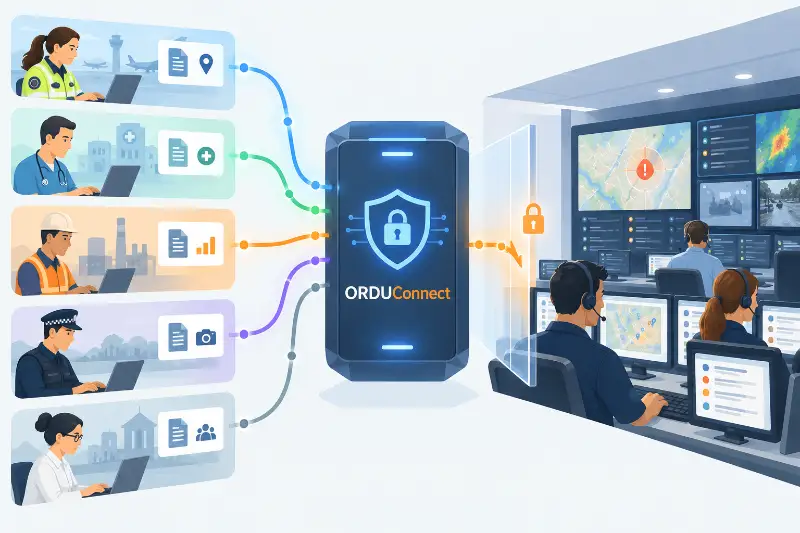
How do you let trusted third parties contribute information to a live multi-agency incident without giving them unnecessary access to the central incident management system, or requiring them to open their own systems in return? That is one of the problems ORDU Connect is built to solve.
Newsletter
Connect on LinkedIn